
What Are the Challenges of Manual Televiewer Interpretation?
Manually picking acoustic and optical televiewer logs is time-consuming, introduces interpreter bias, and leaves valuable historical data unanalyzed. Automating the first pass removes the logging bottleneck while keeping geologists in control of the final interpretation.
Acoustic televiewer (ATV) and optical televiewer (OTV) surveys provide a continuous, oriented image of the borehole wall. Converting those raw images into a reliable structure table, however, remains a largely manual bottleneck. A geologist or geotechnical engineer must trace, measure, and classify every discontinuity by hand, one borehole at a time.
This article examines where manual televiewer logging loses time and consistency—and how Structura, the automated televiewer interpretation platform developed by engineers at BGC Engineering, resolves those constraints.
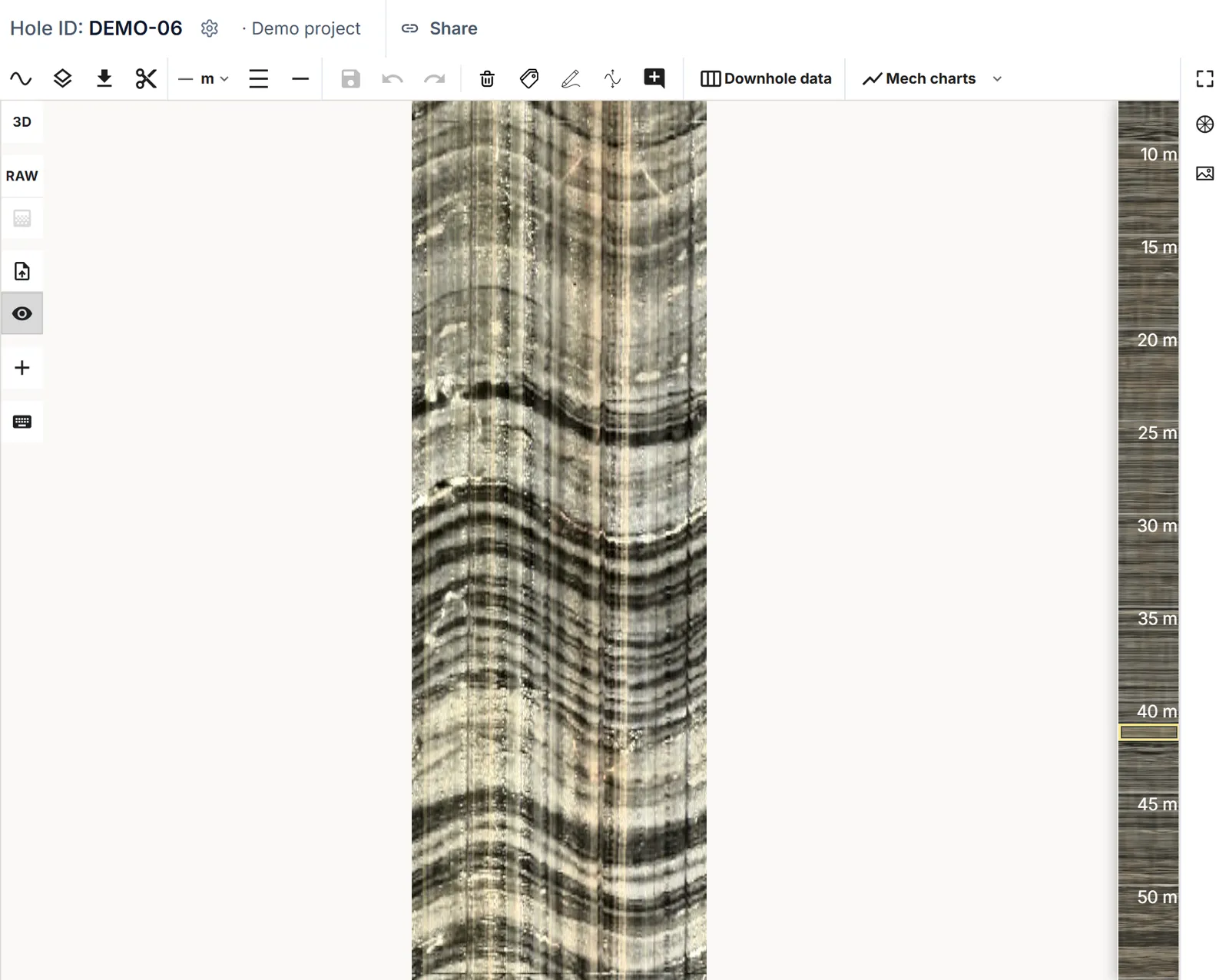
What does manual televiewer interpretation involve?
On an unrolled televiewer image, any planar structure intersecting the borehole appears as a sinusoid. To log it, an interpreter manually fits a sinusoidal trace to the feature. Once the image is oriented, the amplitude and phase of that curve yield the structure’s dip and dip direction. The interpreter then classifies the feature—such as a joint, bedding plane, vein, or fault, whether open or closed—and estimates its aperture. Because a single borehole can intersect hundreds of structures, logging an entire drilling programme requires thousands of repetitive manual picks.
Why is manual televiewer logging slow and inconsistent?
Logging backlogs grow with every drill hole
Manual picking is repetitive work that consumes the time of the specialists best qualified to analyze the broader geotechnical model. When drilling outpaces manual processing, unlogged televiewer files sit in a queue. During a 39-hole validation pilot at Rio Tinto Kennecott Copper, automating the initial pick with Structura reduced processing time from roughly 40 hours to 5 minutes per hole, cutting overall data turnaround by an estimated 67% (Kennecott case study, SSIM 2025).
Different interpreters produce different structure tables
Even experienced loggers differ in which features they pick, how closely they fit a sinusoid, and how they assign structural classifications. Ask two interpreters to log the same borehole, and you will often get two noticeably different structure tables. In the Kennecott validation study, Structura’s automated picks closely matched manual orientation trends while reducing subjective interpreter bias.
Orientation errors are difficult to detect
A single mistake in image orientation skews the dip and dip direction of every structure in the borehole. Once those values are exported to a static spreadsheet, the underlying error is nearly impossible to spot. Catching orientation errors requires an independent second pass over the raw log—a quality-control step teams rarely have time to perform manually.
Historical borehole data remains unanalyzed
Many mine sites and exploration projects hold archives of legacy televiewer logs that were either never interpreted or logged years apart using inconsistent criteria. Because reprocessing legacy holes by hand is prohibitively expensive, valuable structural data sits unused in digital archives.
What is Structura?
Structura is a cloud-based geotechnical logging platform hosted on Microsoft Azure and built by engineers at BGC Engineering to automate televiewer data processing. You can upload raw ATV and OTV logs directly in WellCAD (.wcl), ALT/Mount Sopris (.tfd), or Robertson (.hed, .lgx) formats. Structura identifies, measures, and classifies the structures in under five minutes per borehole.
For each picked discontinuity, Structura outputs true orientation, structure type, aperture, and roughness, alongside a continuous image-quality log that flags low-clarity intervals for closer human review. When processing acoustic logs, Structura also generates estimated rock strength, Rock Quality Designation (RQD), joint condition, and Rock Mass Rating (RMR). To date, geotechnical teams have used Structura across more than 40 mine and exploration sites to process over 500,000 metres of televiewer data.
How do teams use automated televiewer interpretation in practice?
Structura is designed to deliver a rapid, consistent first pass rather than an unverified final answer. After the model completes its initial picks, a geologist or geotechnical engineer inspects the results in Structura’s built-in QA/QC viewer. There, the reviewer can add subtle features, refine apertures, adjust classifications, and share the borehole with colleagues for sign-off. Once approved, data exports cleanly as CSV tables, formatted PDF borehole logs, and stereonets ready for downstream modelling packages.
Because Structura applies the exact same detection criteria to every file, teams can also batch-process historical archives and compare legacy boreholes directly against newly drilled holes. Our next post—How to Automate Televiewer Data Interpretation in Minutes—walks through this workflow step by step.
Frequently Asked Questions
Does automated televiewer interpretation replace the geologist?
No. Structura automates the repetitive mechanics of tracing, measuring, and classifying sinusoids. A geologist or geotechnical engineer reviews the picks, adds missed features, and refines classifications before any data is exported. Final professional sign-off always remains with the interpreter.
Which televiewer file formats can Structura process?
Structura reads acoustic (ATV) and optical (OTV) televiewer logs in WellCAD (.wcl), ALT and Mount Sopris (.tfd), and Robertson (.hed, .lgx) formats.
Has Structura's automated interpretation been field-validated?
Yes. Structura was benchmarked against manual logging, blind test datasets, and physical drill core across 39 boreholes at Rio Tinto Kennecott Copper. The full methodology and results are published in the SSIM 2025 paper: Automated televiewer data interpretation and validation: an applied case study at Kennecott Copper.